
In a few words
Detailed information
Why choose Ruby Pro Powder
- Stabilized ruby red: the formulation with 2 pigments (E122, E153) is calibrated to reproduce the warm and radiant shade of a genuine ruby. The result remains deep and luminous after drying, without shifting to candy pink or coral orange as often seen with low-quality red colorants.
- Compatible with tempered chocolate: the powder form adds no water molecules that would cause white chocolate to grain or set prematurely when coloring. You can transform tempered white chocolate into stunning ruby chocolate for making decorative plaques, molded candies, or signature decorations, without affecting fluidity or crystallization.
- Performance on delicate bases: the powder blends in without loosening Italian meringues, without softening royal icing, or weighing down buttercreams. You maintain perfect textures and stability, where a liquid colorant would soften the preparation.
- Long-lasting preservation: the powder form keeps for several years in its closed jar, protected from moisture, unlike liquid colorants which can oxidize, partially dry out, or lose intensity over time.
- Dual application method: direct brush application for shaded and gradient effects (ideal on fondant flowers or modeled figurines), or dilution in lemon extract or food-grade alcohol for edible painting with sharp lines.
- Cost-effective per gram: 5 g of concentrated powder equals the intensity of several bottles of liquid coloring. The per-gram consumption is especially advantageous for regular professional production.
- Rainbow Dust reference: British brand recognized since 1995 in the professional Cake Design sector. A mark of quality and product consistency for repeated shop productions, ideal for high-stakes chromatic event orders such as weddings or prestigious birthdays.
Detailed technical features
| Feature | Value |
|---|---|
| Brand | Rainbow Dust (United Kingdom) |
| Reference | Pro Powder Ruby |
| Product type | Concentrated powdered food coloring |
| Color | Deep ruby red (Ruby) |
| Content | 5 g (resealable pot) |
| Composition | Colorants E122 (Azorubine), E153 (Vegetable carbon) |
| Solubility | Soluble in lemon extract or food-grade alcohol |
| Application method | Dry dusting OR liquid painting after dilution |
| Compatible surfaces | Fondant, fondant icing, royal icing, buttercream, meringue, tempered chocolate, cookies, macarons |
| Food profile | 100% edible, GMO-free, no taste alteration |
| Origin | United Kingdom |
Instructions: dry brush application
- Surface preparation: ensure the surface is completely dry. On fondant, wait 10 to 15 minutes after spreading for the surface to harden slightly. On tempered chocolate, wait for full crystallization (minimum 30 minutes).
- Brush preparation: use a fine food-grade brush with soft bristles, completely dry. Any moisture will cause pigment clumps that mark the surface unevenly.
- Picking up pigment: tap the brush tip into the pot to take a small amount of powder. Then tap the brush above the pot to remove excess.
- Progressive application: apply with light tapping or circular motions on the surface. The color intensifies gradually with each pass, allowing you to precisely control the final effect.
- Shaded and gradient effects: for a gradient, start from a central point with more pigment, then blend outward by reducing pressure. Ideal for reproducing rose petal effects, red shades on modeled fruits, or warm chromatic transitions.
- Fixation: the powder naturally adheres to moist or very smooth surfaces. On already dry fondant, you can fix it by lightly brushing with vodka to anchor the pigment permanently.
- Final precaution: before handling, gently blow or tap the piece on clean parchment paper to remove unfixed particles and avoid transferring pigment to other production pieces.
Instructions: edible diluted paint
- Choice of thinner: Rainbow Dust recommends lemon extract for diluting Ruby Pro Powder, which adds a tangy note compatible with red fruits and contemporary desserts. Otherwise, neutral vodka, sugar-free kirsch, grain alcohol at minimum 40°, or Rainbow Dust’s Rejuvenator Spirit specifically designed for diluting food powders.
- Mix preparation: pour a small tip of Ruby powder into a ceramic dish or glass container. For individual production, the equivalent of a knife tip is more than enough.
- Progressive dilution: add 3 to 5 drops of the chosen thinner with a pipette or dropper. Mix with a toothpick or brush until you get a creamy consistency, similar to slightly thick India ink.
- Flow test: the paint should flow easily from the brush without forming thick drops. If too thick, add 1 drop of thinner. If too liquid, add a bit of powder.
- Application with fine brush: use a fine brush for details or a flat brush for surfaces. The paint dries in 2 to 5 minutes depending on the amount of thinner evaporated. You can rework areas as long as the thinner has not evaporated.
- Layering: for an extremely intense ruby red or maximum opacity, apply 2 successive layers, waiting for complete drying between each coat.
- Mix storage: prepare only the amount needed for the day’s production. The thinner evaporates and the mixture thickens within a few hours in open air.
Professional applications: 7 use cases
1. Coloring tempered white chocolate ruby style
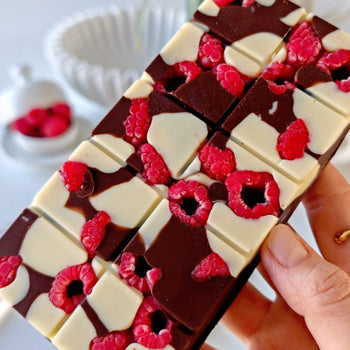
Key application of Ruby: transforming tempered white chocolate into ruby red chocolate for making decorative plaques, signature macaron shells, high-end molded candies, or event decorations. The powder is incorporated directly into melted chocolate without graininess or tempering issues. Visual effect comparable to natural ruby chocolate without the high purchase cost.
2. Valentine’s Day and love creations
Strong seasonality in February: decoration of sugar paste hearts, modeled roses, romantic lettering on decorated cookies, love-themed cupcakes. Ruby red brings an intense visual warmth perfect for Valentine’s Day orders, marriage proposals, and couple anniversaries.
3. Traditional weddings and passionate red palette
For red passion themed weddings or traditional Hindu weddings (where red symbolizes prosperity and happiness), Ruby stands as the chromatic reference. Decoration of tiered red and gold cakes, sugar paste modeled flowers, stylized henna patterns on ivory fondants.
4. Christmas and festive decorations
Decoration of contemporary Yule logs (ruby touches on chocolate glaze), Christmas cookies (stars, trees, mittens), sugar paste figurines (Santa Claus, elves). Deep ruby red brings the expected visual warmth to year-end creations and perfectly complements traditional Christmas green-gold-white palettes.
5. Buttercreams and deep red butter creams
Direct incorporation into buttercreams (Italian, Swiss, French, American) to achieve a uniform ruby red. The powder adds no moisture, the consistency remains perfectly airy and smooth. Ideal for piping on cupcakes and layer cakes with a red velvet or red velvet-inspired theme.
6. Decoration of fruits and berries in sugar paste
Dry application to enhance the realism of sugar paste modeled fruits: strawberries, raspberries, cherries, pomegranates, candy apples. Ruby allows natural shaded effects by layering strokes with different intensities, for a hyper-realistic result.
7. Prestigious birthdays and high-end events
For VIP birthdays, corporate galas, luxurious red and gold themed events, deep ruby red marks sweet creations with a chromatic intensity worthy of grand occasions. Combined with the golden markers from the Cake Art Pen range, the red and gold finish reaches a recognizable high-end level.
Patissland usage tips
- Brush dedicated to color: keep a brush specifically for Ruby. The pigment is very opaque and would color any other light color used afterward with the same brush. Mark the handle of your brush with a touch of red pigment to avoid confusion in the lab.
- Shade test on sample: before large-scale production, test the result on a small piece of your exact base. Depending on the composition of fondant, chocolate, or buttercream, absorption may slightly alter the final intensity.
- Diluent at minimum 40°: for dilution, never use water (which soaks the base and melts the sugar) nor sweet alcohols like liqueurs (which add extra sugar). Lemon extract, neutral vodka, sugar-free kirsch, or Rejuvenator Spirit are the recommended options.
- Progressive coloring of white chocolate: to transform tempered white chocolate into ruby chocolate, add the powder in small successive amounts, mixing 1 to 2 minutes with a spatula between each addition. Check the shade on a cooled chocolate scrap to evaluate the final result after crystallization.
- Precaution for aprons and work surfaces: the powder is highly pigmented and stains fabrics, light work surfaces, and tile grout permanently. Prepare a dedicated area with parchment paper under the mixing bowl.
- Store away from moisture: keep the jar tightly closed, at room temperature (15-25°C), away from direct light and moisture. Use a perfectly dry spoon to take powder, never a damp one.
- Close the jar immediately: do not leave the jar open during decoration; particles fly away at the slightest draft and material loss is rapid.
- Combination with other pigments: Ruby can be lightened with a touch of white (to get a dusty pink) or intensified with Black Magic (to get a very deep burgundy). Test ratios on a sample before production.
Professional FAQ
Difference between Ruby and a classic red?
Ruby is a warm, deep red shade, slightly edged with violet tones, evoking the ruby gemstone. A classic red is purer, brighter, sometimes more orange. Ruby suits warm and prestigious settings (weddings, celebrations), while a classic red is better for festive or playful themes (colorful Christmas, children's birthdays).
How much production with a 5 g jar?
For dry use to create shaded effects or light dusting, one jar covers about 80 to 120 individual pieces. For diluted paint use, expect 200 to 300 pieces depending on the fineness of the designs. For incorporation into buttercream, one jar colors about 1 kg of cream to an intense ruby red. For coloring tempered white chocolate, one jar colors 800 g to 1 kg.
Compatible with tempered white chocolate?
Yes, perfectly. The powder blends directly into the melted white chocolate without graininess or causing the chocolate to seize. For an even red, mix for 2 to 3 minutes with a spatula until the particles are fully dispersed. The color remains stable during tempering and after crystallization. Ideal for creating ruby chocolate-style decorations without having to buy the more expensive real ruby chocolate.
Does the red turn pink or orange?
No, the Ruby formulation is calibrated to remain a true deep red after drying and crystallization. This is one of the major problems with low-quality red dyes that turn candy pink (loss of saturation) or coral orange (pigment instability). The balanced combination of E122 and E153 guarantees long-lasting chromatic stability.
Can it be used for coloring macarons?
Yes, incorporate into Italian or French meringue before macaronage, starting with a very small amount then adjusting gradually. Be careful not to add too much to avoid loosening the meringue. For surface decoration of baked shells, apply with a fine brush using diluted paint ideal for precise patterns or red marbling effects.
Does the pigment resist baking?
Yes, for low-temperature baking (meringues 90-100°C), maintaining excellent chromatic stability. For high-temperature baking (biscuits baked at 180°C), the color may slightly fade or shift chromatically. Recommendation: for decorated biscuits, incorporate Ruby into the royal icing after baking rather than into the biscuit dough itself.
Is it suitable for creations intended for children?
The composition contains dye E122, which requires a mandatory warning about its possible effects on activity and attention in children. For orders specifically intended for young children or schools, this warning should be communicated to the ordering client and massive use avoided (prefer surface decoration rather than full coloring).
How to avoid pigment clumps during dilution?
Pour the thinner gradually (drop by drop at first), mix thoroughly with a toothpick, and crush any lumps against the side of the dish. The ideal consistency is creamy like slightly thick India ink. Too rapid dilution systematically creates lumps that would mark the surface unevenly.
Does the product contain GMOs?
No, Ruby Pro Powder is guaranteed GMO-free, compliant with the strictest European food standards. You can offer it in stores or use it in productions intended for customers attentive to this criterion.
Is it suitable for CAP Pastry candidates?
Absolutely, the jar format and long shelf life are perfectly suited for the CAP kit. The powder is accepted by examination juries. Particularly useful for tests requiring chromatic work on entremets, royal icing, optional cake design decoration, or coloring sugar paste for figurines.
To go further
- Order Preparation: 0 to 2 working days
- France, Belgium, Germany: 1 to 2 working days
- Europe: 2 to 5 working days
- Click & Collect Osny: 24-48h
- FR, BE, DE: based on weight
- Europe: based on country and weight
- Click & Collect Osny: Free