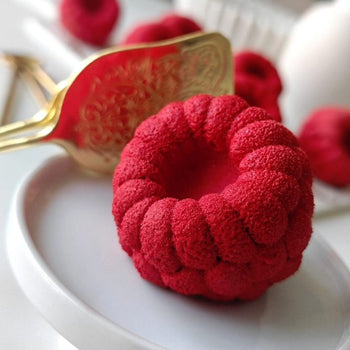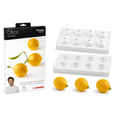
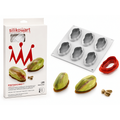


Lemon Trompe-l'œil Mold — Cédric Grolet Collection for Pavoni (8 cavities, 85 ml)
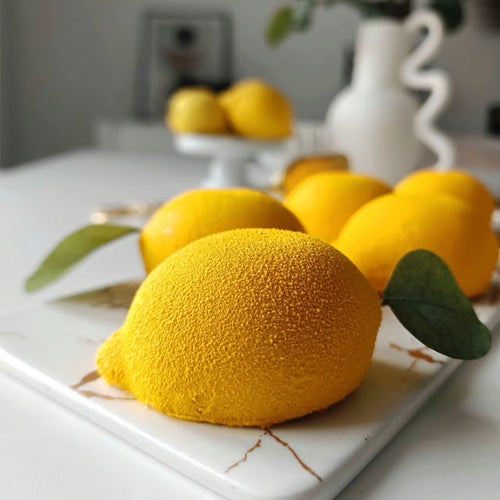
Create spectacular trompe-l'œil desserts with the Cédric Grolet Lemon Mold, from the exclusive collection developed with Pavoni by the Best Pastry Chef in the World 2017. This platinum silicone mold perfectly reproduces the shape of a lemon, with zest details, organic curves, and authentic proportions — to make the 3D individual entremets that made Cédric Grolet world-famous. A must-have reference for contemporary cake design and high-end pastry.
At Patissland, we distribute the entire Cédric Grolet collection for Pavoni: lemon, hazelnut, chestnut, saint-honoré, vanilla pods. The lemon mold is the iconic model of the range; it is THE creation that propelled Cédric Grolet to the top of the pastry world with his "Lemon Tart Trompe-l'œil" served at Meurice. Today, this mold allows any professional pastry chef or advanced amateur to reproduce these exceptional desserts in their own kitchen.
Detailed technical specifications
8-cavity format — efficient professional production
Each mold has 8 silicone cavities to produce 8 individual desserts per batch. Ideal size for professional pastry chefs managing daily orders (shop, caterer, restaurant) and for advanced amateurs hosting 6-8 guests. With 2 molds, you make 16 pieces at once — a size compatible with medium receptions without complex management.
Mold and cavity dimensions
Dimensions of the entire mold: 30 × 17.5 cm
Dimensions of one cavity: Ø 5.3 cm × height 7 cm
Volume per cavity: 85 ml — balanced individual portion, neither too large nor too small
Total mold yield: 680 ml (8 × 85 ml)
The 85 ml size corresponds to the standard for high-end individual entremets — generous enough for 3-4 layered textures (confit insert + creamy layer + mousse + glaze), yet contained enough for an elegant tasting without being heavy.
Realistic trompe-l'œil details — unique cavities
The originality of this mold: each cavity is slightly different, with subtle variations in details (slight surface ripples, bulge variations). This is intentional — Cédric Grolet wanted to reproduce the fact that no two real lemons are ever identical. Your 8 desserts will each have their own character, like real fruits picked from the basket. This detail makes all the difference between a convincing trompe-l'œil dessert and an artificial look.
Professional food-grade platinum silicone
Made of platinum silicone (platinum-cured silicone) — the highest quality food-grade silicone available. Unlike standard silicone, platinum silicone:
• Never alters the taste of your preparations
• Releases no substances into food, even at high temperatures
• Maintains its elasticity over time (does not harden)
• Resists repeated thermal shocks without degrading
It is the material used in all kitchens of major Michelin-starred restaurants.
Extreme thermal resistance: -40°C to +250°C
The mold withstands an exceptional temperature range: from -40°C to +250°C. This range allows all uses:
Freezing / deep freezing: to set mousses and creamy fillings before unmolding, essential for sharp pieces
Oven baking: soaked biscuits, lemon financiers, individual tart bases
Thermal shock resistance: go from freezer to oven directly without cracking
Wider range than most silicone molds on the market (often -40°C to +220°C).
Simple maintenance — dishwasher safe
After use, the mold is cleaned: 1/ By hand with warm soapy water (recommended method to extend the life of the silicone), 2/ In the dishwasher on normal setting (possible but slightly accelerates silicone aging over time). Platinum silicone does not absorb odors or food coloring — after washing, it comes out perfectly clean.
Avoid sharp objects (knives, forks) that could cut the surface.
The Cédric Grolet universe: history and signature
Who is Cédric Grolet?
Cédric Grolet is now considered one of the best pastry chefs in the world. Pastry chef at the Meurice in Paris and then at the Opera, he revolutionized contemporary pastry with his trompe-l'œil aesthetics — desserts that perfectly imitate the appearance of real fruits but hide several sophisticated textures inside. Titles: Best Restaurant Pastry Chef in the World 2017, Best Pastry Chef in the World 2018 by The Best Chef Awards, author of bestsellers "Fruits", "Opéra" and "Pâtisserie" (Ducasse Books).
History of the Grolet × Pavoni collection
Pavoni is the Italian manufacturer of professional silicone molds of reference since 1983 — used in all the major houses worldwide (Ladurée, Fauchon, Pierre Hermé, Dalloyau). In 2018, Pavoni and Cédric Grolet signed an exclusive partnership to reproduce the chef's signature creations in mold format. The collection now includes: lemon (the original model), hazelnut, chestnut, vanilla pods, saint-honoré. Each mold is designed from 3D scans of the chef's real creations.
Why lemon is the iconic model
The Lemon Trompe-l'œil Tart is the creation that launched Cédric Grolet onto the international stage. First published on Instagram in 2016, it generated millions of views and laid the foundation for a whole trend — that of "realistic fruit" desserts hiding complex gastronomic compositions. Even today, it is the most photographed dessert at the Meurice. This mold gives you access to the exact shape that made Grolet a pastry legend.
Cédric Grolet's book "Fruits" — reference
To master the technique fully, Cédric Grolet's book "Fruits" (Ducasse Books, 2017) details the complete recipe for the Lemon Trompe-l'œil: Menton lemon cream, lemon confit, lemon mousse, yellow velvet coating. It is THE absolute reference for reproducing the authentic dessert in its entirety. The book is available in French, English, Japanese, and Korean — a worldwide success with over 100,000 copies sold.
Technique for making the lemon trompe-l'œil
Structure of a trompe-l'œil entremet (4 textures)
The typical Grolet recipe has 4 stacked textures:
Core: a very concentrated lemon confit insert (zest + juice + sugar, cooked long) — gives the flavor explosion at the center
Heart surround: a smooth lemon cream (juice, eggs, whipped butter) — rich and long-lasting mouthfeel
Main body: a light lemon mousse based on Italian meringue + juice + gelatin — airy structure
Finishing: lemon yellow velvet spray to reproduce the rough texture of real lemon skin
Step 1 — Prepare the lemon confit inserts
Prepare your lemon confit inserts in a mini silicone half-sphere mold (Ø 2.5 cm), freeze them solid. This is essential: a soft insert would mix with the mousse and ruin the textural contrast effect. Count 8 inserts for 1 full mold. Bright yellow color obtained by cooking the zest + juice + sugar for 30-40 minutes until thick jam consistency.
Step 2 — Prepare the lemon cream
The lemon cream is traditionally made: lemon juice + eggs + sugar + butter, cooked at 82°C in a bain-marie, then cooled and blended with an immersion blender to incorporate air. Spread the cream in a thin layer in a medium flexible mold (Ø 3.5 cm half-sphere), insert the confit insert in the center, freeze. You get a double core "cream + confit" to insert into the mousse.
Step 3 — Lemon mousse and assembly in the mold
Prepare the lemon mousse with Italian meringue + lemon juice + gelatin + whipped cream. Fill each cavity of the Grolet mold 70% with mousse, insert the frozen core in the center, fill with the remaining mousse smoothing flush. Tap the mold lightly on the work surface to release air bubbles. Freeze for at least 6 hours, ideally overnight for perfect freezing.
Step 4 — Unmolding and velvet spray
Once frozen, unmold carefully: the platinum silicone’s flexibility allows you to remove the pieces intact without breaking surface details. Place the entremets on a rack, then apply the yellow lemon velvet spray (made from colored cocoa butter) from 10-15 cm away — this creates the rough texture characteristic of lemon skin. The velvet spray sets instantly on contact with the frozen pieces. Defrost 2-3 hours in the refrigerator before tasting.
Chocolate variant — "lemon in white chocolate" version
Simplified version for beginners or chocolatiers: pour tempered white chocolate colored yellow directly into the mold in a thin layer, then set it in the cold. You get a lemon-shaped chocolate shell that you can fill with ganache or praline. Easier than the full entremet but just as visually impressive. This variant is very popular in Easter or Christmas chocolateries.
Who is this mold for?
Professional pastry chefs — shop, caterer, restaurant
Professional pastry chefs use this mold to offer a high-end signature piece in their display — a lemon trompe-l'œil entremet sold for €6-12 each depending on city/positioning. The Instagram-friendly look naturally drives store traffic. For wedding caterers, it’s THE piece that leaves a lasting impression during cocktail receptions. Gourmet restaurants use it as a signature dessert on the menu.
Advanced amateurs — Grolet technical challenge
For advanced enthusiasts who have already mastered the basics of pastry (creams, mousses, frozen inserts, glazes), recreating a Grolet at home is THE ultimate challenge. It's a full weekend project (2 days of spread-out preparation), but the result is worth it: you can reproduce in your kitchen a dessert that would sell for €12 at Meurice. The guests' reactions are well worth the technical effort.
Teachers and pastry schools — educational
The pastry schools (CAP, Bachelor, ENSP Yssingeaux, Ferrandi, Lenôtre) regularly use Grolet molds to teach advanced techniques: creamy fillings, confits, frozen inserts, airy mousses, velvet glazes. It is the ideal teaching tool for a "contemporary pastry" module — recognizable shape + multiple techniques + photogenic result for student portfolios.
Food stylists and culinary photographers
For culinary photo shoots, trompe-l'œil desserts are extremely photogenic: instantly recognizable shape (a lemon), textured surface that plays with light, bright color. Food stylists working for magazines, social media, or brand campaigns frequently use these Grolet molds for visual productions. If you are a pastry content creator on Instagram/TikTok, this mold guarantees high-performing photos.
Complementary Patissland products
Other molds from the Cédric Grolet × Pavoni collection
Complete your Grolet collection at Patissland:
• Hazelnut Trompe-l'œil mold — with the iconic shell shape
• Chestnut Trompe-l'œil mold — realistic chestnut skin texture
• Vanilla Pod mold — for long entremets
• Saint-Honoré style mold — modern interpretation of the classic
Owning the complete collection allows you to offer several seasonal variations in display or restaurant menu.
Lemon yellow velvet spray
Essential for achieving the authentic look: the yellow velvet spray (colored cocoa butter) is applied on frozen, unmolded pieces, from 15 cm away. Creates the rough matte texture characteristic of real lemon skin. Patissland offers several brands: Callebaut PowerFlowers, PCB Creation, Silikomart. Spray in 2-3 light passes for even coverage without dripping.
Molds for inserts (Silikomart half-spheres)
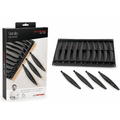
To make the confit and creamy inserts at the heart of the entremet, you need small silicone half-sphere molds: Ø 2.5 cm for the confit, Ø 3.5 cm for the creamy + confit insert. Patissland offers the corresponding Silikomart molds that stack easily in the freezer. Huge time saver compared to DIY.
Yellow food colorings for sugar paste or mousses
If you want to tint your lemon mousse to enhance the bright yellow, Patissland offers a range of food colorings: Colour Mill (water-dispersible, ideal for white chocolate), gel colorings for sugar paste, concentrated powdered food colorings. For lemon, a bright yellow shade with a slight green tint (a touch of lime green) gives the most natural result.
Cake drums and bases for presentation
To present your individual Grolet desserts on a display tray, Patissland offers: 12 mm white cake drum for display, 4 mm silver bases rectangular for transport and elegant presentation. The silver base particularly enhances yellow entremets (chromatic contrast).
Frequently asked questions
What is the difference between this mold and the Pavoni KE057 mold?
This mold is the "Lemon Trompe-l'œil Mold" signature of the Cédric Grolet × Pavoni collection — format 8 cavities, Ø 5.3 cm × h 7 cm, 85 ml volume per cavity, with subtle variations between cavities typical of Grolet’s philosophy. This is the mold that exactly reproduces the signature "Lemon Tart" served at Meurice. Check the dimensions carefully before purchase if you are looking for a precise reference to reproduce a published recipe.
Do you need to be very experienced to use this mold?
To achieve a result close to Grolet: yes, advanced pastry experience is necessary (creamy, mousses, frozen inserts, velvet spray). Expect a good level of enthusiast who has already made several entremets or attended training.
For simplified use: you can very well use it to pour colored white chocolate (shells), simple mousse without insert, or even frozen yogurt for children. The mold itself is not difficult — it’s the Grolet recipe that is technical.
Can the Grolet lemon tart be faithfully reproduced?
Yes, the complete recipe is published in the book "Fruits" by Cédric Grolet (Ducasse Books, 2017) with all exact proportions and detailed techniques. With this mold + the book + quality ingredients (Menton lemon juice, couverture cocoa butter, 200 Bloom gelatin), you will achieve a result very faithful to the original from Meurice. The only potential difference: the chef’s skill acquired over 20 years of practice.
How long does preparation take for 8 pieces?
For a complete Grolet entremet with double insert (confit + creamy) + mousse + velvet spray: allow 2 days spread out:
• Day 1: prepare the confit and creamy inserts, freeze them separately (2-3 hours of active work + overnight freezing)
• Day 2: prepare the mousse, assemble the entremets in the mold, freeze (1 hour of work + minimum 6 hours freezing)
• Finishing: unmolding + velvet spray (20 min)
• Thawing: 2-3 hours in the refrigerator before serving
Total technique: about 4 hours of active work spread over 2 days.
Can it be unmolded warm or must it be frozen?
For mousse entremets: freezing is mandatory. An unfrozen mousse cannot be unmolded without deforming — it is physically impossible to achieve the trompe-l'œil details on a soft material. The mousse must be frozen solid.
For oven baking (financiers, soft cookies): unmold while warm, shortly after removing from the oven (10 min rest). The flexibility of silicone allows for clean unmolding.
For tempered chocolate: unmold once the chocolate is fully crystallized (2-3h at 17°C).
Does the mold yellow over time?
Platinum silicone does not yellow even after hundreds of uses — this is one of the major advantages of this premium material vs standard silicone. Some low-end silicones yellow in areas exposed to heat or fats — not Pavoni silicone. Your mold will keep its white/translucent appearance for years of intensive use.
What is the average lifespan?
With careful use (preferably hand washing, no sharp utensils, flat storage): a Pavoni platinum silicone mold lasts 5-10 years in domestic use and 2-5 years in intensive professional use (multiple uses per week). Signs of end of life: loss of elasticity, small cracks at the corners, difficulty unmolding. At that point, replace with a new one as degraded silicone can release micro-particles.
Where can I see a video example of the technique?
Cédric Grolet has published several official tutorials on his Instagram account (@cedricgrolet) and on the YouTube channel "Cédric Grolet". His slow-motion teardown videos revealing the inside of the trompe-l'œil have gone viral and are extraordinary educational references. You can also find TV reports and documentaries (Canal+, Netflix series "Chef's Table: Pastry").
Is it suitable for frozen desserts sold in the deli section?
Yes, perfectly. Grolet entremets are naturally products that keep very well frozen (texture stable up to 2-3 months at -18°C). Many professional pastry chefs produce in batches and store in the freezer, thawing on demand for display. The velvet spray is applied only when taken out of the freezer — the mold itself perfectly withstands repeated freeze/thaw cycles thanks to its thermal range of -40°C to +250°C.
How to store the mold between uses?
Store the mold flat (not folded, not rolled) in a dry and temperate place. Ideally in its original box or on a dedicated shelf. Avoid crushing it under heavy objects (this could deform the impressions over time). Avoid direct sunlight and heat sources (oven, radiator). A well-stored mold retains its elasticity and sharp details for years.
- Order Preparation: 0 to 2 working days
- France, Belgium, Germany: 1 to 2 working days
- Europe: 2 to 5 working days
- Click & Collect Osny: 24-48h
- FR, BE, DE: based on weight
- Europe: based on country and weight
- Click & Collect Osny: Free